9.4.2. Kaplan-Meier Analysis
The main difference between Life Table and Kaplan-Meier Analysis is that while cases are aggregated into time intervals in the former, the latter estimates the survival function on individual cases without any aggregation. The Kaplan-Meier estimate of the survival function is given by:
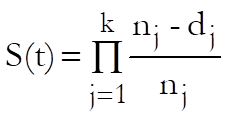
where:
· dj = number of deaths at interval j, and
· nj = number of cases entering interval j.
This is similar to the Life Table estimate of the survival function except that the number of cases entering interval j here replaces the average at risk in Life Table.
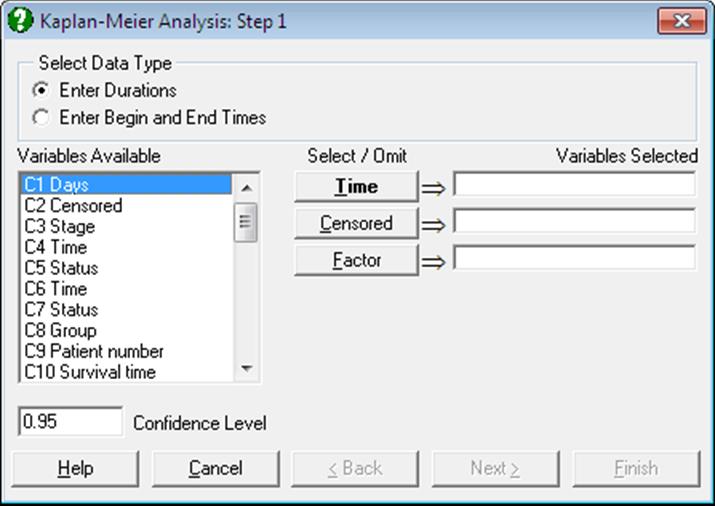
Variables are selected as described at the beginning of this chapter (see 9.4.0. Survival Variable Selection). If a factor variable has been selected, then a further dialogue will allow levels of the factor to be selected for analysis.
The Output Options Dialogue will provide access to the following four options:
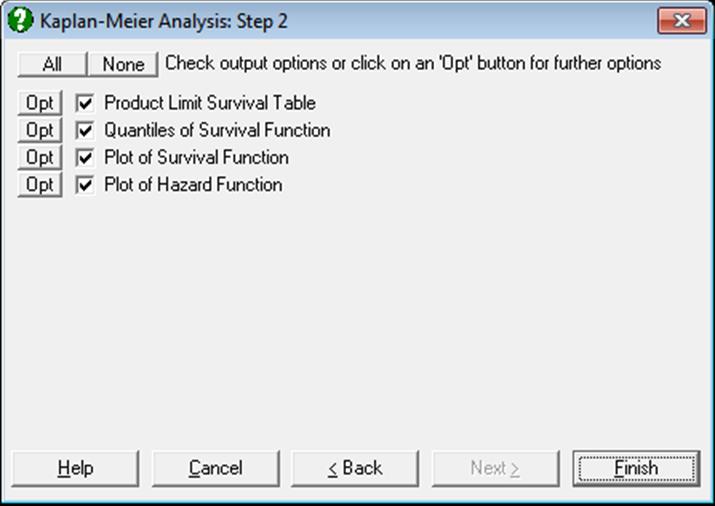
9.4.2.1. Product Limit Survival Table
The Kaplan-Meier estimate of the survival function is also called the product limit estimator. The Kaplan-Meier Analysis has the advantage over Life Table analysis in that its results do not depend on grouping of the data into intervals. The product limit method is like a Life Table with a single observation in each interval.
The survival and hazard functions are estimated and they are displayed together with their standard errors and confidence intervals for a user-defined confidence level.
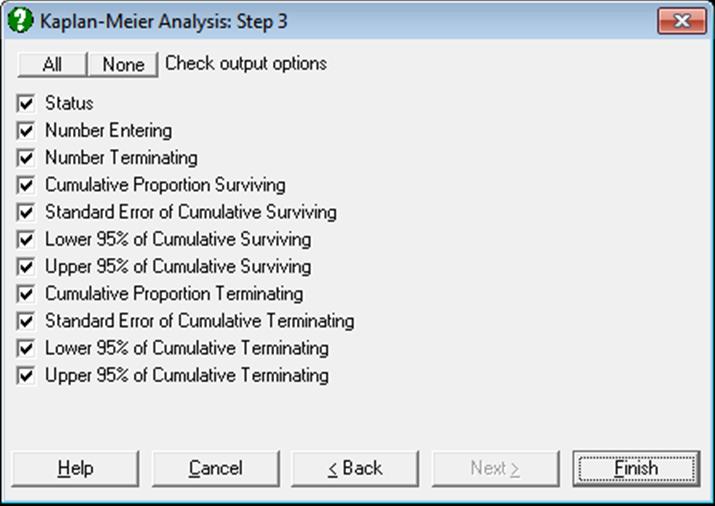
Status: This indicates whether a case is censored. By default, 0 is censored (the termination time is not known) and non-zero values are uncensored (terminating at this time period).
Number Entering:
nj: The number of cases that enter the interval.
Number Terminating:
dj: The number terminating is the number of cases that reach the terminal event within the interval.
Cumulative Proportion Surviving:
The cumulative proportion surviving is the proportion of cases that have not reached the terminal event by the end of the interval.
Standard Error of Cumulative Surviving:
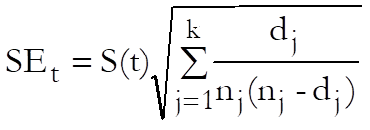
The standard error of cumulative proportion surviving is computed from Greenwood’s formula.
Confidence Intervals of Cumulative Surviving:
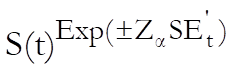
where the log-transformed standard error is:
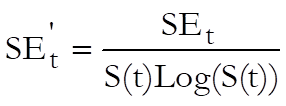
SEt (the standard error reported in the table) is not used in computing the confidence intervals, employing the standard Z distribution, because it often leads to values outside the valid range of 0 to 1. The significance level can be set to any value between 0 and 1 from the Variable Selection Dialogue.
Cumulative Proportion Terminating:
1-S(t): This is the cumulative proportion of cases that have reached the terminal event by the end of the interval and it is equal to one minus cumulative proportion surviving.
Standard Error of Cumulative Terminating:
SEt: This is identical to the standard error of cumulative proportion surviving.
Confidence Intervals of Cumulative Terminating:
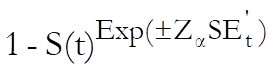
This is equal to one minus confidence intervals of surviving.
9.4.2.2. Quantiles of Survival Function
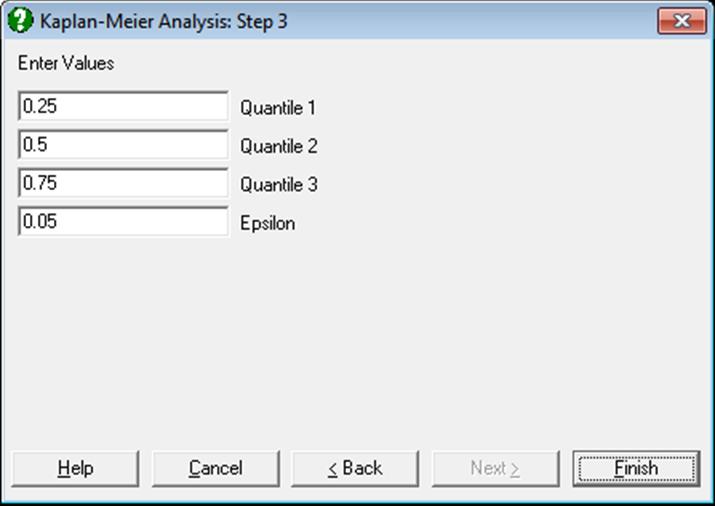
With this procedure it is possible to estimate the mean and up to three quantiles of the survival function. The quantiles are set to quartiles by default, but you can edit these to any values between 0 and 1. The value of epsilon (0.05 by default), which is used in estimating the standard error of quantiles, can also be changed. The mean and quantiles, as well as their standard errors and confidence intervals, are displayed in a table.
The mean survival time is computed as:
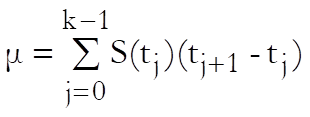
and its standard error is:
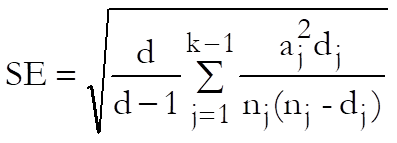
where:
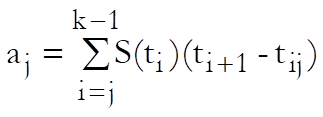
and d is the total number of cases terminating.
The quantile 100p (where p = 0.5 is the median) of the survival function is given as the minimum observed survival time for which the value of the survival function is less than or equal to p. That is:

The standard error of a quantile is calculated from:
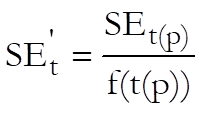
where
 = the
standard error of survival function at t(p),
= the
standard error of survival function at t(p),
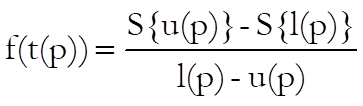
and:


Although the default value for epsilon is 0.05, you can enter any value between 0 and 1.
9.4.2.3. Kaplan-Meier Plots
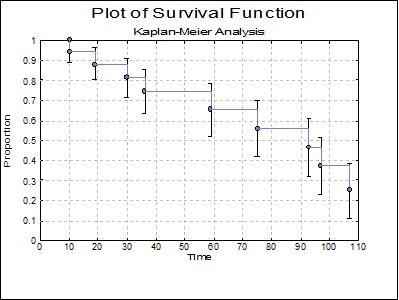
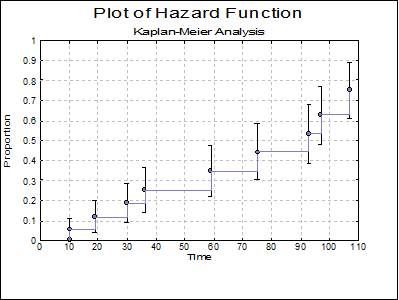
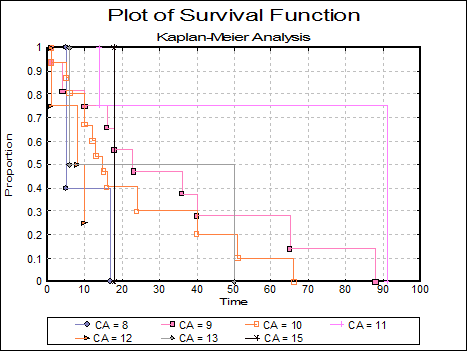
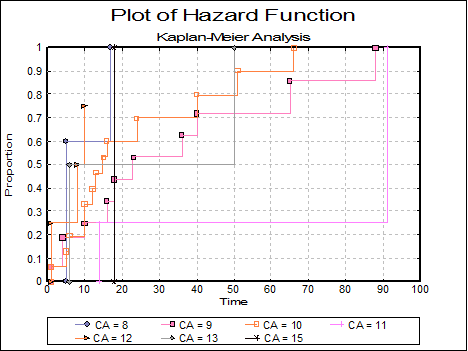
Survival and hazard functions can be plotted. The Edit → Data Series dialogue provides the necessary controls to edit all aspects of the plot. If a factor column is selected, each subgroup’s settings are controlled from a different tab on the same dialogue. There are no limitations on the maximum number of subgroups that can be plotted on one graph, but only the properties of the first nine subgroups can be controlled from the Edit → Data Series dialogue.
The line type is set to Step Right by default (see 4.1.1.1.1. Line), following Armitage and Berry (2002) and Altman (1991). But this can be changed to Step Down following Collett (1994) from the Edit → Data Series → Line dialogue.
It is possible to display standard errors or confidence intervals for each subgroup separately. To do this, first display the graph and then select Edit → Data Series. Clicking on the [Bars…] button, a small dialogue will pop up.
Plot of Survival Function: The cumulative proportion of surviving is plotted against the survival times.
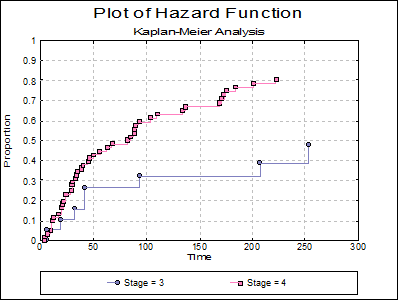
Plot of Hazard Function: The cumulative proportion of terminating is plotted against the survival times.
9.4.2.4. Kaplan-Meier Examples
Example 1
Example 17.1 on p. 578 from Armitage & Berry (2002). Data on survival of patients with diffuse hystiocytic lymphoma by the stage of tumour are given.
Open SURVIVAL and select Statistics 2 → Survival Analysis → Kaplan-Meier Analysis. From the Variable Selection Dialogue click on the data option 1 Enter Durations and select Days (C1) as [Time], Censored (C2) as [Censored] and Stage (C3) as [Factor]. Select Plot of Survival Function as the output option.
Next click on the [Last Procedure Dialogue] button and this time select Product Limit Survival Table. From the next dialogue check only the Stage = 3 box and then select the first 5 boxes from the Output Options Dialogue to obtain the following output:
Kaplan-Meier Analysis
Factor variable: Stage = 3
Time Variable: Days
Censor Variable: Censored
Number of Cases Censored: 11 ( 57.9%)
Valid Number of Cases: 19, 61 Omitted
Product Limit Survival Table
|
Time |
Status |
Number Entering |
Number Terminating |
Cumulative Proportion Surviving |
Standard Error of Cumulative Surviving |
|
6 |
1 |
18 |
1 |
0.9474 |
0.0512 |
|
19 |
1 |
17 |
2 |
0.8947 |
0.0704 |
|
32 |
1 |
16 |
3 |
0.8421 |
0.0837 |
|
42 |
1 |
15 |
4 |
* |
* |
|
42 |
1 |
14 |
5 |
0.7368 |
0.1010 |
|
43 |
0 |
13 |
5 |
* |
* |
|
94 |
1 |
12 |
6 |
0.6802 |
0.1080 |
|
126 |
0 |
11 |
6 |
* |
* |
|
169 |
0 |
10 |
6 |
* |
* |
|
207 |
1 |
9 |
7 |
0.6121 |
0.1167 |
|
211 |
0 |
8 |
7 |
* |
* |
|
227 |
0 |
7 |
7 |
* |
* |
|
253 |
1 |
6 |
8 |
0.5247 |
0.1287 |
|
255 |
0 |
5 |
8 |
* |
* |
|
270 |
0 |
4 |
8 |
* |
* |
|
310 |
0 |
3 |
8 |
* |
* |
|
316 |
0 |
2 |
8 |
* |
* |
|
335 |
0 |
1 |
8 |
* |
* |
|
346 |
0 |
0 |
8 |
* |
* |
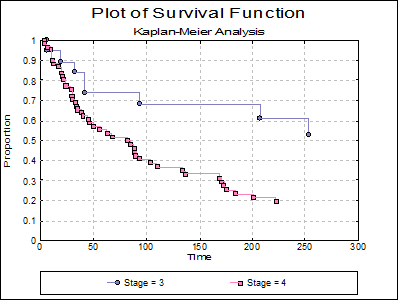
The following graphs are obtained by including stages 3 and 4 in the analysis.
Example 2
Time data in weeks to discontinuation of the use of an IUD is given in Table 1.1 (p. 5), in Collett, D. (1994).
1) Example 2.3 Table 2.2 (p.21) gives the cumulative survival function.
2) Example
2.4 Table 2.3 (p.26) gives the cumulative survival function, its standard error and confidence intervals. The 95% confidence intervals reported by Collett are
computed by using the standard formula 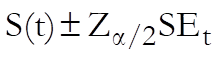 ,
whereas UNISTAT reports the log-transformed confidence intervals.
,
whereas UNISTAT reports the log-transformed confidence intervals.
3) Example 2.9 (p.34) gives median and its 95% confidence intervals for cumulative survival function.
Open SURVIVAL and select Statistics 2 → Survival Analysis → Life Table. From the Variable Selection Dialogue select the data option 1 Enter Durations and Survival time (C4) as [Time] and Status (C5) as [Censored].
Kaplan-Meier Analysis
Time Variable: time
Censor Variable: status
Number of Cases Censored: 9 ( 50.0%)
Valid Number of Cases: 18, 0 Omitted
Product Limit Survival Table
|
Time |
Status |
Number Entering |
Number Terminating |
Cumulative Proportion Surviving |
Standard Error of Cumulative Surviving |
Lower 95% of Cumulative Surviving |
|
10 |
1 |
17 |
1 |
0.9444 |
0.0540 |
0.6664 |
|
13 |
0 |
16 |
1 |
* |
* |
* |
|
18 |
0 |
15 |
1 |
* |
* |
* |
|
19 |
1 |
14 |
2 |
0.8815 |
0.0790 |
0.6019 |
|
23 |
0 |
13 |
2 |
* |
* |
* |
|
30 |
1 |
12 |
3 |
0.8137 |
0.0978 |
0.5241 |
|
36 |
1 |
11 |
4 |
0.7459 |
0.1107 |
0.4536 |
|
38 |
0 |
10 |
4 |
* |
* |
* |
|
54 |
0 |
9 |
4 |
* |
* |
* |
|
56 |
0 |
8 |
4 |
* |
* |
* |
|
59 |
1 |
7 |
5 |
0.6526 |
0.1303 |
0.3438 |
|
75 |
1 |
6 |
6 |
0.5594 |
0.1412 |
0.2564 |
|
93 |
1 |
5 |
7 |
0.4662 |
0.1452 |
0.1830 |
|
97 |
1 |
4 |
8 |
0.3729 |
0.1430 |
0.1209 |
|
104 |
0 |
3 |
8 |
* |
* |
* |
|
107 |
1 |
2 |
9 |
0.2486 |
0.1392 |
0.0468 |
|
107 |
0 |
1 |
9 |
* |
* |
* |
|
107 |
0 |
0 |
9 |
* |
* |
* |
|
Time |
Upper 95% of Cumulative Surviving |
Cumulative Proportion Terminating |
Standard Error of Cumulative Terminating |
Lower 95% of Cumulative Terminating |
Upper 95% of Cumulative Terminating |
|
10 |
0.9920 |
0.0556 |
0.0540 |
0.0080 |
0.3336 |
|
13 |
* |
* |
* |
* |
* |
|
18 |
* |
* |
* |
* |
* |
|
19 |
0.9691 |
0.1185 |
0.0790 |
0.0309 |
0.3981 |
|
23 |
* |
* |
* |
* |
* |
|
30 |
0.9363 |
0.1863 |
0.0978 |
0.0637 |
0.4759 |
|
36 |
0.8970 |
0.2541 |
0.1107 |
0.1030 |
0.5464 |
|
38 |
* |
* |
* |
* |
* |
|
54 |
* |
* |
* |
* |
* |
|
56 |
* |
* |
* |
* |
* |
|
59 |
0.8432 |
0.3474 |
0.1303 |
0.1568 |
0.6562 |
|
75 |
0.7804 |
0.4406 |
0.1412 |
0.2196 |
0.7436 |
|
93 |
0.7097 |
0.5338 |
0.1452 |
0.2903 |
0.8170 |
|
97 |
0.6310 |
0.6271 |
0.1430 |
0.3690 |
0.8791 |
|
104 |
* |
* |
* |
* |
* |
|
107 |
0.5313 |
0.7514 |
0.1392 |
0.4687 |
0.9532 |
|
107 |
* |
* |
* |
* |
* |
|
107 |
* |
* |
* |
* |
* |
Quantiles of Survival Function
Time Variable: time
Censor Variable: status
Number of Cases Censored: 9 ( 50.0%)
Valid Number of Cases: 18, 0 Omitted
Epsilon: 0.05
|
|
Value |
Standard Error |
Lower 95% |
Upper 95% |
|
Mean |
76.3387 |
9.4331 |
57.8502 |
94.8272 |
|
Quantile 1: 25% |
107.0000 |
* |
* |
* |
|
Quantile 2: 50% |
93.0000 |
17.1311 |
59.4237 |
126.5763 |
|
Quantile 3: 75% |
36.0000 |
19.9294 |
* |
75.0610 |