
6.7.1. One Sample
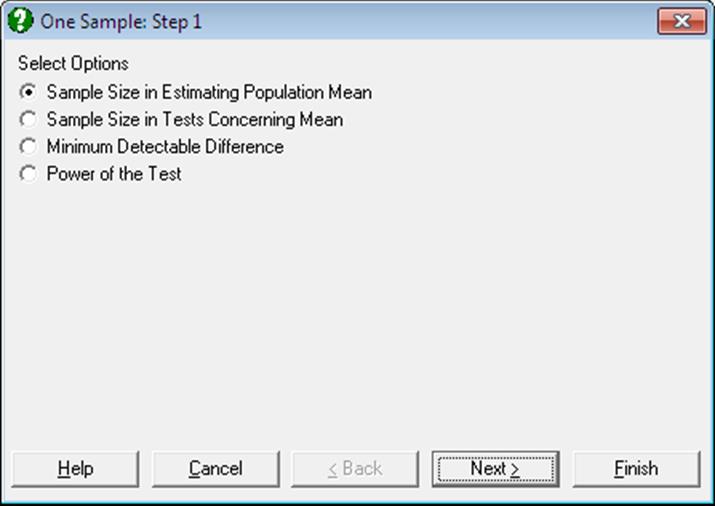
The first procedure provided here concerns estimation of population mean and as such it is inherently different from the last three, which are derived from the same equation, each time solving for a different parameter.
6.7.1.1. Sample Size in Estimating the Population Mean
The sample size necessary to achieve the desired level of precision in estimating a population mean is given by the following formula:
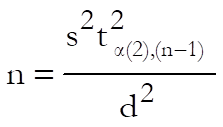
Here:
· s2 is the sample variance with ν degrees of freedom,
· d is the half-width of the desired confidence interval,
· 1 – α is the confidence level,
· 1 – β is the assurance that the confidence interval will not be greater,
·
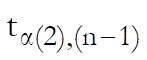 is the two-tailed critical
value for α from t-distribution with (n – 1) degrees of freedom.
is the two-tailed critical
value for α from t-distribution with (n – 1) degrees of freedom.
Since critical value of t on the right hand side of this equation depends on the sample size n, the left hand side cannot be computed directly. Therefore, an iterational convergence algorithm is employed.
The user is expected to enter:
· Denominator Degrees of Freedom
· Sample Variance
· Half-Width of Confidence Interval
· Assurance for Confidence Interval
· Confidence Level
and the program will output the estimated sample size.
Example
Example 7.7 on p. 115 from Zar, J. H. (2010). Select Statistics 1 → Sample Size and Power Estimation → One Sample and the Sample Size in Estimating Population Mean option. Enter the following data at the next dialogue to obtain the Estimated Sample Size:
Sample Size and Power Estimation: One Sample
Sample Size in Estimating Population Mean
|
Denominator Degrees of Freedom = |
2.0000 |
|
Sample Variance = |
0.4008 |
|
Half-Width of Confidence Interval = |
0.2500 |
|
Assurance for Confidence Interval = |
0.9000 |
|
Confidence Level = |
0.9500 |
|
Estimated Sample Size = |
27.0740 |
6.7.1.2. Sample Size in Tests Concerning the Mean
The purpose of the experiment is to test if the sample is
taken from a population with a specified mean “H0: μ = μ0”
or it is from a population with a different mean “H0: μ  μ0”.
μ0”.
Sample size in tests about the mean is determined from:
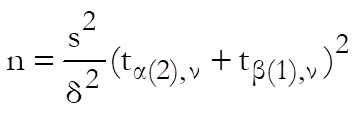
Here:
· s2 is the sample variance with ν degrees of freedom,
· δ is the minimum detectable difference between the two population means at the desired confidence interval,
· α is the probability of committing a Type I error and 1- α is the confidence level, which can be one or two-tailed.
· β is the probability of committing a Type II error and 1 – β is the power of the test,
·
 is the (one or) two-tailed
critical value for α from t-distribution with ν degrees of freedom,
is the (one or) two-tailed
critical value for α from t-distribution with ν degrees of freedom,
·
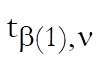 is the one-tailed critical
value for β from t-distribution with ν
degrees of freedom.
is the one-tailed critical
value for β from t-distribution with ν
degrees of freedom.
Since critical values of t on the right hand side of this equation are dependent on the sample size n, an iterational algorithm is employed.
The user is expected to enter:
· Sample Variance
· Minimum detectable difference
· Power of the test
· Confidence Level
· 1 or 2 tailed test
and the program will output the estimated sample size.
Example
Example 7.8 on p. 116 from Zar, J. H. (2010). Select Statistics 1 → Sample Size and Power Estimation → One Sample and the Sample Size in Tests Concerning Mean option. Enter the following data at the next dialogue to obtain the Estimated Sample Size:
Sample Size and Power Estimation: One Sample
Sample Size in Tests Concerning Mean
|
Sample Variance = |
1.5682 |
|
Minimum Detectable Difference = |
1.0000 |
|
Power of the Test = |
0.9000 |
|
Confidence Level = |
0.9500 |
|
1 or 2 Tailed Test = |
2.0000 |
|
Estimated Sample Size = |
18.4991 |
6.7.1.3. Minimum Detectable Difference for One Sample
Rearranging the equation in section 6.7.1.2. Sample Size in Tests Concerning the Mean we obtain:
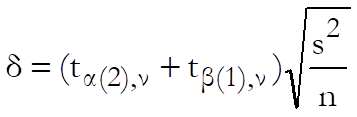
Here, δ can be computed directly, without an iterational algorithm, as all parameters on the right hand side can be computed using the given parameters.
The user is expected to enter:
· Sample Size
· Sample Variance
· Power of the test
· Confidence Level
· 1 or 2 tailed test
and the program will output the minimum detectable difference.
Example
Example 7.9 on p. 117 from Zar, J. H. (2010). Select Statistics 1 → Sample Size and Power Estimation → One Sample and the Minimum Detectable Difference option. Enter the following data at the next dialogue:
Sample Size and Power Estimation: One Sample
Minimum Detectable Difference
|
Sample Size = |
25.0000 |
|
Sample Variance = |
1.5682 |
|
Power of the Test = |
0.9000 |
|
Confidence Level = |
0.9500 |
|
1 or 2 Tailed Test = |
2.0000 |
|
Minimum Detectable Difference = |
0.8470 |
6.7.1.4. Power of the Test for One Sample
Rearranging the equation in section 6.7.1.2. Sample Size in Tests Concerning the Mean we obtain:
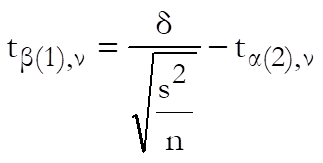
Here,  can be
computed directly, as all parameters on the right hand side can be computed
using the given parameters. Then β is
obtained from t-distribution with ν degrees of freedom.
can be
computed directly, as all parameters on the right hand side can be computed
using the given parameters. Then β is
obtained from t-distribution with ν degrees of freedom.
The user is expected to enter:
· Sample Size
· Sample Variance
· Minimum Detectable Difference
· Confidence Level
· 1 or 2 tailed test
and the program will output the t-statistic and its p-value.
Example
Example 7.10 on p. 118 from Zar, J. H. (2010). Select Statistics 1 → Sample Size and Power Estimation → One Sample and the Power of the Test option. Enter the following data at the next dialogue:
Sample Size and Power Estimation: One Sample
Power of the Test
|
Sample Size = |
12.0000 |
|
Sample Variance = |
1.5682 |
|
Minimum Detectable Difference = |
1.0000 |
|
Confidence Level = |
0.9500 |
|
1 or 2 Tailed Test = |
2.0000 |
|
Power of the Test: |
|
|
t-Statistic = |
0.9480 |
|
2-Tail Probability = |
0.8204 |