
8.2.2. K-th Neighbour Discriminant Analysis
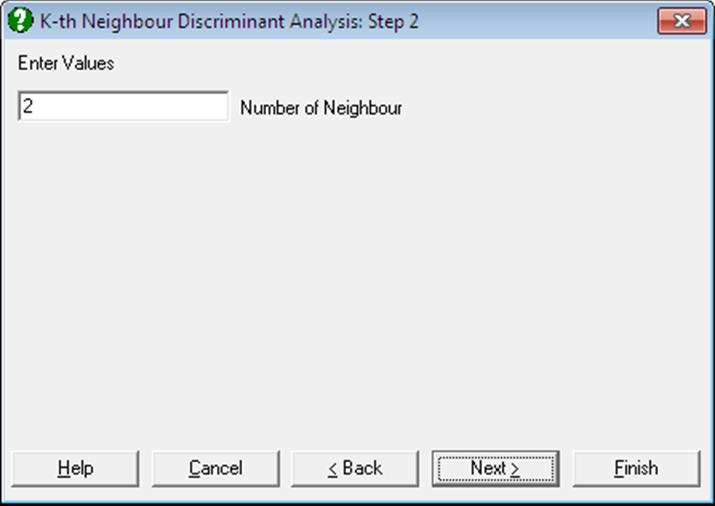
This is a nonparametric discriminant method, which is especially useful when the sample sizes are large. The probability that a point falls within the neighbourhood of a class is based on the distance of the kth nearest point to the centroid. In this way, the effects of outliers can be minimised. The number of neighbour k is provided by the user.
Since the algorithm does not involve computing covariances etc., the output consists only of the classification tables. See Hand, D J (1981).
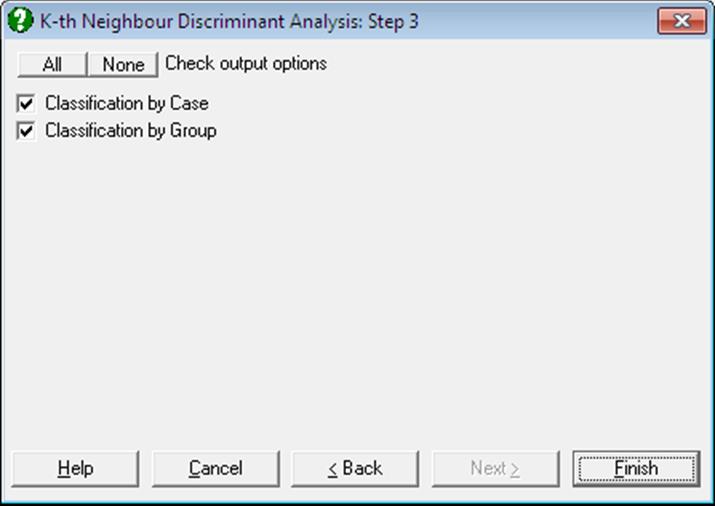
Classification by Case: The form of this output is identical to the Classification by Case output in section 8.2.1.3. Canonical Discriminant Analysis.
Classification by Group: The form of this output is identical to the Classification by Group output in section 8.2.1.3. Canonical Discriminant Analysis.
Example
Let us solve the example for the Multiple Discriminant Analysis using the Kth neighbour method (see 8.2.1.4. Discriminant Examples).
K-th Neighbour Discriminant Analysis
Variables Selected: Perf, Info, Verbexp, Age
Classification by Case
|
|
ActGroup |
Miscls |
EstGroup |
Probability |
|
1 |
1 |
|
1 |
0.5000 |
|
2 |
1 |
|
1 |
0.5000 |
|
3 |
1 |
|
1 |
0.5000 |
|
4 |
2 |
* |
1 |
0.5000 |
|
5 |
2 |
* |
1 |
0.5000 |
|
6 |
2 |
|
2 |
0.5000 |
|
7 |
3 |
* |
1 |
0.5000 |
|
8 |
3 |
* |
1 |
0.5000 |
|
9 |
3 |
* |
1 |
0.5000 |
Classification by Group
|
|
1 |
2 |
3 |
|
1 |
3 |
0 |
0 |
|
|
100.00% |
0.00% |
0.00% |
|
2 |
2 |
1 |
0 |
|
|
66.67% |
33.33% |
0.00% |
|
3 |
3 |
0 |
0 |
|
|
100.00% |
0.00% |
0.00% |
Correctly Classified: 44.44%