
6.5.8. Cochran’s Q
Data for this test must be in dichotomised form, i.e. in terms of 0 and 1. The hypothesis tested is whether three or more matched sets of frequencies or proportions differ significantly among themselves.
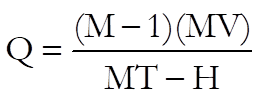
where V is the sum of C2 – T2, H is the sum of R2 when Cs are column totals, Rs are row totals and T is sum total. Q has a chi-square distribution with M – 1 degrees of freedom. Missing values are not supported.
Example 1
Table 84 on p. 224 from Cohen, L. & M. Holliday (1983). Frequency of correct solutions to each of four problems by ten subjects are given. The null hypothesis “there is no significant difference in difficulty of the four problems” is tested.
Open NONPARM2, select Statistics 1 → Nonparametric Tests (Multisample) → Cochran’s Q and select Problem 1, Problem 2, Problem 3 and Problem 4 (C17 to C20) as [Variable]s to obtain the following results:
Cochran’s Q
|
|
Cases |
0 |
1 |
|
Problem 1 |
10 |
4 |
6 |
|
Problem 2 |
10 |
3 |
7 |
|
Problem 3 |
10 |
3 |
7 |
|
Problem 4 |
10 |
1 |
9 |
|
Total |
40 |
11 |
29 |
|
Number of Columns = |
4 |
|
Number of Rows = |
10 |
|
Chi-Square Statistic = |
1.9655 |
|
Degrees of Freedom = |
3 |
|
Right-Tail Probability = |
0.57959 |
This result is not significant at the 10% level. Hence do not reject the null hypothesis.
Example 2
Example 12.6 on p. 282, Zar, J. H. (2010). A researcher wants to test the null hypothesis “the proportion of humans attacked by mosquitoes is the same for all 5 clothing types” at a 95% confidence level.
Open NONPARM2, select Statistics 1 → Nonparametric Tests (Multisample) → Cochran’s Q and include Light loose, Light dark, Dark long, Dark short and None (C21 to C25) in the analysis by clicking [Variable] to obtain the following results:
Cochran’s Q
|
|
Cases |
0 |
1 |
|
Light loose |
8 |
6 |
2 |
|
Light dark |
8 |
4 |
4 |
|
Dark long |
8 |
4 |
4 |
|
Dark short |
8 |
1 |
7 |
|
None |
8 |
3 |
5 |
|
Total |
40 |
18 |
22 |
|
Number of Columns = |
5 |
|
Number of Rows = |
8 |
|
Chi-Square Statistic = |
6.9474 |
|
Degrees of Freedom = |
4 |
|
Right-Tail Probability = |
0.1387 |
Since the right tail probability is greater than 5%, do not reject the null hypothesis.