
7.4.4. Regression with Replicates
This is a test of linearity for bivariate regressions when the data contains multiple measurements of the dependent variable for each value of the independent variable. The null hypothesis tested is “population regression is linear” against the alternative hypothesis “population regression is not linear”.
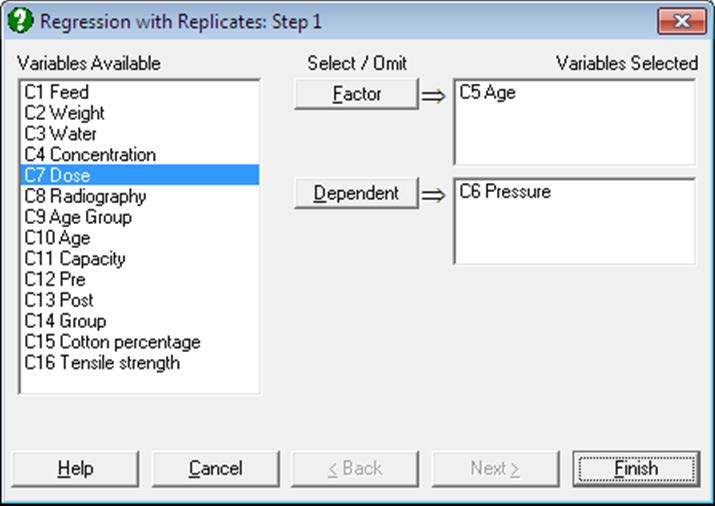
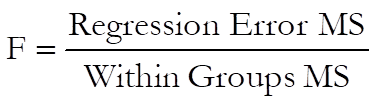
Select at least one variable as [Factor] and at least one data variable as [Dependent]. The procedure is run separately for each [Factor] / [Dependent] pair. Output consists of simple regression results, and ANOVA of regression table (testing the null hypothesis that “the slope of the regression line is zero”), another ANOVA table where the among groups variation is broken down into the Linear Regression and its error sum of squares. The test statistic is the F-test for regression error term, which is defined as:
Example 1
Examples 17.8a and 17.8b on pp. 349, 350 from Zar, J. H. (2010). The null hypothesis that “the population regression is linear” is tested at a 95% confidence level.
The table format given in the book can be transformed into the factor format by using UNISTAT’s Data → Stack Columns procedure and the Level() function (see 3.4.2.5. Statistical Functions). All data on systolic blood pressure should be stacked in a column Pressure (the Y variable) and all data on ages (the X variable) should be expanded to form a column Age to keep track of the age groups of pressure measurements.
Open ANOTESTS, select Statistics 1 → Tests for ANOVA → Regression with Replicates and select Age (C5) as [Factor] and Pressure (C6) as [Dependent] to obtain the following results:
Regression with Replicates
Regression results
|
Constant = |
68.7849 |
|
Slope = |
1.3031 |
|
R-squared = |
0.9827 |
|
Standard Error = |
2.5702 |
ANOVA of regression
|
Due To |
Sum of Squares |
DoF |
Mean Square |
F-stat |
Prob |
|
Regression |
6750.289 |
1 |
6750.289 |
1021.819 |
0.0000 |
|
Error |
118.911 |
18 |
6.606 |
|
|
|
Total |
6869.200 |
19 |
361.537 |
|
|
Test of linearity
|
Due To |
Sum of Squares |
DoF |
Mean Square |
F-stat |
Prob |
|
Among groups |
6751.933 |
4 |
1687.983 |
215.916 |
0.0000 |
|
Regression |
6750.289 |
1 |
6750.289 |
863.454 |
0.0000 |
|
Error |
1.644 |
3 |
0.548 |
0.070 |
0.9750 |
|
Within groups |
117.267 |
15 |
7.818 |
|
|
|
Total |
6869.200 |
19 |
361.537 |
|
|
Since the probability value for Regression in the ANOVA of regression table is less than 5% reject the null hypothesis that “the regression slope is zero”. The test of linearity is the F-statistic on regression error, which is 0.070 with a 97.5% probability, therefore do not reject the null hypothesis of linearity.
Example 2
Example 11.2 on p. 316 in Armitage & Berry (2002). Data on radiographic assessments of bone healing for three doses of vitamin D are given.
The format of Table 9.3 in the book is not suitable for analysis in UNISTAT. All data should be stacked in a single column Radiography and a factor column Dose created to keep track of the group memberships.
Open ANOTESTS, select Statistics 1 → Tests for ANOVA → Regression with Replicates and select Dose (C7) as [Factor] and Radiography (C8) as [Dependent] to obtain the following results:
Regression with Replicates
For Radiography, classified by Dose
|
Constant = |
1.2195 |
|
Slope = |
0.7876 |
|
R-squared = |
0.2399 |
|
Standard Error = |
1.2408 |
ANOVA of regression
|
Due To |
Sum of Squares |
DoF |
Mean Square |
F-stat |
Prob |
|
Regression |
14.089 |
1 |
14.089 |
9.151 |
0.0052 |
|
Error |
44.645 |
29 |
1.539 |
|
|
|
Total |
58.734 |
30 |
1.958 |
|
|
Test of linearity
|
Due To |
Sum of Squares |
DoF |
Mean Square |
F-stat |
Prob |
|
Among groups |
16.992 |
2 |
8.496 |
5.699 |
0.0084 |
|
Regression |
14.089 |
1 |
14.089 |
9.451 |
0.0047 |
|
Error |
2.903 |
1 |
2.903 |
1.948 |
0.1738 |
|
Within groups |
41.742 |
28 |
1.491 |
|
|
|
Total |
58.734 |
30 |
1.958 |
|
|
The test of linearity is the F-statistic on regression error, which is 1.948 with a 17% tail probability. Therefore, do not reject the null hypothesis of linearity.