
6.5.6. Kendall’s Concordance Coefficient
This test is particularly useful for evaluating various readings on the same set of variables. Each variable is ranked and its mean rank is found. The test statistic is calculated as follows:
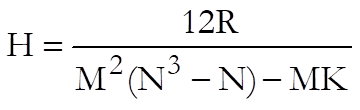
where R is the sum of squared differences from the mean rank and K is the sum of k3 – k and k is the number of tied cases for a particular rank.
Data entry is in matrix format (see 6.0.5. Tests with Matrix Data). Columns selected for this test must have equal number of rows and rows containing at least one missing value are omitted.
The test statistic displayed is corrected for ties. For each variable the rank sum and mean rank are displayed. The correction factor is also reported. One-tail probability is obtained using the chi-square distribution with M – 1 degrees of freedom.
WARNING! For this procedure UNISTAT expects the data to be entered as variables in rows and cases in columns. If the data is not already in this form, use Data Processor’s Data → Transpose Matrix facility to obtain the correct format.
Example
Example 20.5 on p. 450, Zar, J. H. (2010). The data table given in the book needs to be transposed to run the test in UNISTAT. The null hypothesis “there is no association among the three variables” is tested at a 95% confidence level.
Open NONPARM2, select Statistics 1 → Nonparametric Tests (Multisample) → Kendall’s Concordance and include C1 to C12 in the analysis by clicking [Variable] to obtain the following results:
Kendall’s Concordance Coefficient
|
|
Cases |
Rank Sum |
Mean Rank |
|
C1 |
3 |
14.5000 |
4.8333 |
|
C2 |
3 |
21.0000 |
7.0000 |
|
C3 |
3 |
30.5000 |
10.1667 |
|
C4 |
3 |
6.0000 |
2.0000 |
|
C5 |
3 |
11.0000 |
3.6667 |
|
C6 |
3 |
3.5000 |
1.1667 |
|
C7 |
3 |
20.0000 |
6.6667 |
|
C8 |
3 |
11.5000 |
3.8333 |
|
C9 |
3 |
29.0000 |
9.6667 |
|
C10 |
3 |
28.5000 |
9.5000 |
|
C11 |
3 |
22.5000 |
7.5000 |
|
C12 |
3 |
36.0000 |
12.0000 |
|
Total |
36 |
234.0000 |
6.5000 |
|
Number of Columns = |
12 |
|
Number of Rows = |
3 |
|
Coefficient = |
0.9241 |
|
Correction for Ties = |
15.0000 |
|
Chi-Square Statistic = |
30.4965 |
|
Degrees of Freedom = |
11 |
|
Right-Tail Probability = |
0.0013 |
Since the right tail probability is less than 5% reject the null hypothesis.